

Author’s Note: To penetrate this topic deeply, I draw from my personal, lived experience practicing the religion, katholikos. This essay references specifics of my spirituality not because it assumes you, the reader, share them, but rather to ensure the topic this essay touches on becomes concrete and specific, rather than vague and abstract. Remain open and do whatever helps you connect to the spirit of this essay. You may want to “translate” certain portions into your own words in order to effectively contemplate what I present here.
A brief bit about katholikos to further contextualize: Katholikos is a Greek work that, in English, literally means “Universal”. It’s the combination of two words:
- kata (concerning)
- holos (whole – the same root from which we get the English word, “holistic”)
As a religion, katholikos (more commonly called “Catholicism”) teaches that every human is a unique icon of God and has a sacred calling to actively share, and share in, God’s Divine life. The best one-sentence distillation of katholikos was written by St. Athanasius who lived between 296 and 373 AD. He wrote:
“God became man, so that man might become God.”
I. Introduction
“Will you work today?”
It sounds odd, but I felt the seed of this question when I was 17 years old. At the time, I believed I was going through a spiritual and existential crisis. In the grand scheme of things, this was actually a very positive and healing time in my life (though I could not see it as such at the time).
Providence was moving such that long-standing, false beliefs I had carried up to this point were being surfaced and I was gifted with the experience of having to see, feel, look, and (therefore) consider them for the first time. One of these false beliefs was this:
“If something is physical, then it is not spiritual.”
At the time, I could not articulate this belief succulently, but it nonetheless existed and exerted a force in my life. Early expressions of it are found in letters I wrote to spiritual advisers at the time:
(November 17, 2008)
“I’ve become very depressed because when I have joyful thoughts of marriage, I feel that they are bad and that I will never be able to feel them again. I look at all my hobbies and interests outside my spiritual life as a waste of time. I think I just need to be reminded that things like falling in love with someone or finding joy in physical activities like parkour are good and holy.”
(December 28, 2008)
“I think I’m taking life too seriously. I’m becoming so focused on the spiritual side of life that everything physical seems useless. When I get into this mind set, I can’t enjoy sports or any form of recreation.”
Those two excerpts may sound abnormal, and they were, but over the years I’ve found that they simply make explicit what exists in many individuals as an implicit belief:
“Work is a necessary evil.”
That is why we use phrases like “work-life balance” and “less doing, more being” as if “work” was the opposite of “life” and “doing” was the opposite of “being”.
A good example of this kind of unspoken philosophy is articulated in the book, He Leadeth Me by Walter J. Ciszek, S.J., which documents the life of a priest who spent 23 years in Soviet Union labor camps and solitary confinement.
“’In the sweat of your brow,’ God said to Adam in the Garden, ‘you shall eat your bread till you return to the ground, for out of it you are taken; you are dust, and to dust you shall return.’ Traditionally, man has looked upon that divine injunction as a curse and upon work as a punishment for sin. Many a man, surely, has looked upon work itself as a curse, a necessary evil – especially the boring, day-to-day labor of a routine job. He does it because by it he earns a living, feeds his family, provides for their welfare and their future and his own security against old age. But he does not have to enjoy it, and by and large he does not.”
And yet so much of our life is “work”. Although I disagree with the categorization, in one sense, a day (24 hours) can be viewed as 3 sets of 8 hours: 8 hours of sleeping, 8 hours of “working”, and 8 hours of everything else (family time, personal time, etc.).
If work is that which we do in order to do other things, then what do we make of the time in which we work? Is it simply the “reality of life” that we spend 1/3 of our lives in something that isn’t inherently meaningful? How is this time spiritually significant?
In this essay, we’ll explore two primary dimensions of work: work as collaborative and work as redemptive. In doing so, we will have an opportunity to reconsider our image of work and our image of mysticism.
II. Work As Collaborative
Imagine a young 4-year-old girl and her father in the kitchen of their house on a Sunday afternoon. It’s daddy-daughter time and the young girl is thrilled by the idea of learning how to make cookies. Look around in the room. See the flour, the butter, the chocolate chips on the kitchen counter. Mom is taking a much-needed break in the family room. Dad is eager to successfully make these cookies and bond with his little girl. The little girl is jittery with excitement and can’t believe this day is finally here. She’s already imagining herself with one of those fancy, white hats on, opening a bakery in town.
“Okay, honey” dad starts off, “we’ll do this at the same time so that you can follow along. Here’s your supplies and here’s mine.”
The little girl’s face quickly changes.
“Making cookies can get a little messy, so you’ll practice making them with your toys, while I show you how to make them over here with the real ingredients.”
The girl clearly looks disappointed. “But I want to make real cookies, Dad.”
“I know I know, but first you need to practice with your set,” he quickly replies while at the same time realizing that this isn’t going as planned.
Eventually the dad concedes and lets his daughter over to his side. “Okay, fine – come over here.”
“Yayyy!” The girl jumps over to dad’s side and immediately grabs an egg.
“WAIT! Be careful with that! Eggs can break really easily. Here, you want to hold it like…”
“No, I want to do it, daddy! I want to do it by myself!”
What does this scenario demonstrate? Three things:
1. Children Love to Work.
For a child, work is an utter delight. If you are a parent, you know this intimately. Children literally love to work. The way they play is by working. One day I’ll walk outside, and my girls will be playing “Timber Works” (the name of a local Tree Care business). Another day I’ll walk outside, and they’ll be running a restaurant, making “stuffed mushrooms” out of walnuts and cicada shells.
If you pause a child during play and ask what they are doing, they will looking you in the eye and say “I am working.”
2. Children Only Like Real Work.
Any child will choose a “real” spatula over a “toy” spatula. They want to work with the same thing daddy and mommy work with. They prefer wood and metal over plastic. They appreciate the weight and significance.
3. Children Want to “Do It on Their Own.”
To an untrained ear, “No, I want to do it, daddy! I want to do it by myself!” is the sound of an impatient and spoiled child. To a trained ear, it is the sound of someone who is eager to participate in a meaningful way.
Yes, there can sometimes be a disordered way in which someone expresses “No, I want to do this on my own.” But that is not what one typically encounters in a child. When young, this feeling of “I want to do it on my own” is a desire for meaningful participation rather than a rejection of help or advice.
Re-encountering work from the eyes of a child helps us appreciate and realize the significance of work. Work is an honor, work is an adventure, work is exciting.
This shakes up the common, and largely unconscious, view of work as “punishment” or work as “a necessary evil.”
To take the scriptural reference provided by Ciszek, many people read “In the sweat of your face you shall eat bread…” and mistakenly interpret that as God punishing man with work. Though common, that interpretation is not the one held by the oldest Christian tradition.
Rather than a curse, work is a blessing. It is precisely because humans bear the divine image of the Creator that they are endowed with the gift of creativity. They can create because they have had the breath of the creator infused in them.
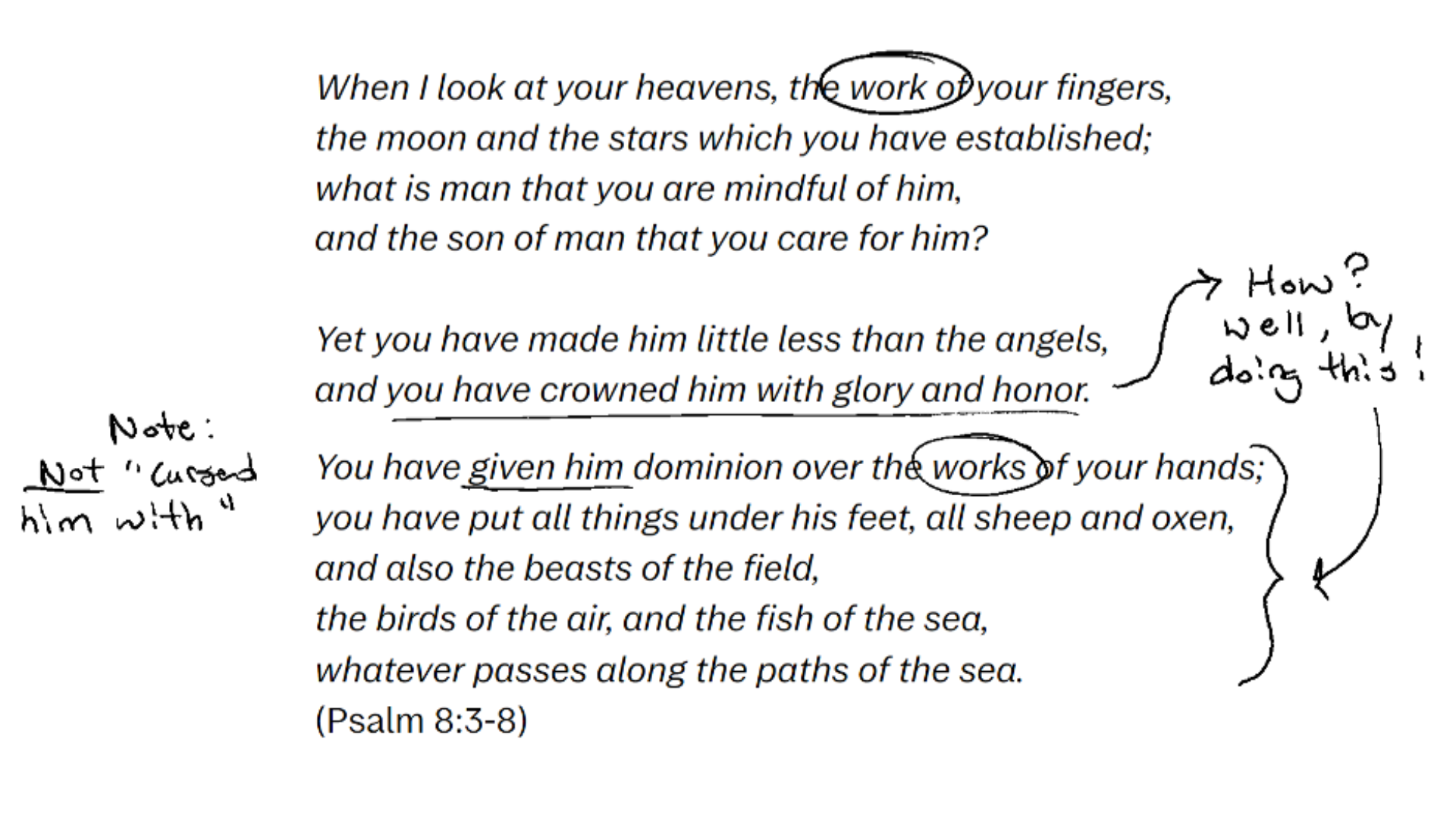
Work is not a “result of the fall” – only sweat is!
“Even had man never fallen from the state of innocence, he would not have remained wholly idle,” writes Pope Leo XIII in his 1891 encyclical, Rerum Novarum. Rather, work would’ve been man’s “free choice” and “delight”.
Why?
Because “work is a fundamental dimension of man’s existence on earth,” writes Pope St. John Paul II. “It is not only good in the sense that it is useful or something to enjoy; it is also good as being something worthy, that is to say, something that corresponds to man’s dignity, that expresses this dignity and increases it.” (Laborem Exercens, 1981)
Reflecting on the reality that God chose to spend 30 years on earth “simply” working (Mt 13:54-56) means that work is not “merely a symbolic action like that of the politician who sweeps one section of a sidewalk to launch a cleanup campaign or turns the first spadeful of earth at a groundbreaking ceremony.” (Ciszek, 108)
Work is not an “add-on” for God. Work is Godly. It is, ultimately a divine act proper to God. Work is the “creating” that a “Creator” does.
The description of Pharaoh’s relationship with Joseph is a fitting image to the kind of glory God calls us to by inviting us to participate in His creative life:
“…you shall be over my house, and all my people shall order themselves as you command; only as regards the throne will I be greater than you.’ And Pharaoh said to Joseph, ‘Behold, I have set you over all the land of Egypt.’ Then Pharaoh took his signed ring from his hand and put it on Joseph’s hand, and arrayed him in garments of fine linen, and put a gold chain about his neck; and made him to ride in his second chariot; and they cried before him, ‘Bow the knee!'” (Gen 41:40-43)
III. Work As Redemptive
But we know that work isn’t always a joy. We feel that first-hand and can’t simply ignore or sugar coat this. So then what is true? If work is our glory, why can it be monotonous and painful?
Monotony
Part of what makes work monotonous is our inattentiveness. Usually the reverse is believed: we become inattentive when work is monotonous. There are senses in which that is surely true, but it is more true that our inattentiveness comes first.
Our lack of attention usually comes from repetition or from repudiation.
In regard to repetition, we are inattentive to repeated things when we lack what G.K. Chesterton calls “the eternal appetite of infancy.”
“All the towering materialism which dominates the modern mind rests ultimately upon one assumption: a false assumption. It is supposed that if a thing goes on repeating itself it is probably dead; a piece of clockwork. People feel that if the universe was personal it would vary; if the sun were alive it would dance. This is a fallacy even in relation to known fact. For the variation in human affairs is generally brought into them, not by life, but by death; by the dying down or breaking off of their strength or desire. A man varies his movements because of some slight element of failure or fatigue… The very speed and ecstasy of…life [has] the stillness of death. The sun rises every morning. I do not rise every morning; but the variation is due not to my activity, but to my inaction. Now, to put the matter in a popular phrase; it might be true that the sun rises regularly because he never gets tired of rising. His routine might be due, not to a lifelessness, but to a rush of life. The thing I mean can be seen, for instance, in children, when they find some game or joke that they specially enjoy. A child kicks his legs rhythmically through excess, not absence of life. Because children have abounding vitality, because they are in spirit fierce and free, therefore they want things repeated and unchanged. They always say, ‘Do it again”; and the grown-up person does it again until he is nearly dead. For grown-up people are not strong enough to exult in monotony. But perhaps God is strong enough to exult in monotony. It is possible the God says every morning, ‘Do it again’ to the sun; and every evening, ‘Do it again’ to the moon. It may not be automatic necessity that makes all daisies alike; it may be that God makes every daisy separately but has never got tired of making them. It may be that He has the eternal appetite of infancy.” (Orthodoxy, G.K. Chesterton)
In regards to repudiation, we often lose presence of mind, we become too focused on attaining some particular future end and aren’t fully present while we move toward that end. We forget that “every step of the journey is the journey”.
We assume the speed of our desires is the speed of life and are disappointed and deflated by the gap between the two.
What’s right in front of us seems too “obvious” or too “ordinary” to be the material out of which our dreams are built.
For whatever reason, when we place things behind words like “after” or “once” or “then”, they seem to be more vibrant and enchanting. We can slip into thinking that the future is sacred, and the present is profane.
When in this state of mind, where we subtly repudiate the present, the words from this homily act like a splash of cold water to the face:
“People have tried to present the Christian way of life as something exclusively spiritual – or better, spiritualistic – something reserved for pure, extraordinary people who remain aloof from the contemptible things of this world, or at most tolerate them as something that the spirit just has to live alongside, while we are on this earth…
Stop dreaming. Leave behind false idealisms, fantasies, and what I usually call mystical wishful thinking: If only I hadn’t married; if only I had a different job or qualification; if only I were in better health; if only I were younger; if only I were older. Instead turn to the most material and immediate reality, which is where our Lord is: Look at my hands and my feet, said the risen Jesus, be assured that it is myself; touch me and see; a spirit has not flesh and bones, as you see that I have…
Any attempt to escape from the noble reality of daily life is, for you men and women of the world, something opposed to the will of God.” (“Passionately Loving the World” by St. Josemaría Escrivá)
Pain
Darker than monotony is the reality of pain. It is on this aspect that it’s most appropriate for Ciszek to speak directly to us:
“If ever there was a man for whom work was a curse and a burden without any redeeming features, it must be the worker in a slave labor camp…
We worked because we had to work in order to eat, to live, to survive. To work was the purpose of our having been deported to these camps; there was no other reason for our existence. There were millions of us, and it did not really matter to those in charge of the camps who lived and who died; they could not be bothered feeding unproductive mouths.
Work was surely a curse under these conditions. The prisoners hated work, they hated the officials who made them work, and they hated the government that had condemned them to these cruel occupations. Only the fact that they had to work to get enough food to live on, to survive, made them report dumbly and mechanically each morning for the labor brigades and march off across the arctic wastes, arms locked behind their backs to face another day’s quota of work. The urge to survive was what made them do it, the thought of survival was all they had to live for and all they lived by, They did as much work as they had to in order to survive, and avoided as much work as they could possibly avoid and still manage to survive. The work was not important, but the food was; and even the food was important only because without it a man could not survive for long. What was important was to get through the day.
There was nothing ennobling about work in the slave labor camps. Except for the need to work enough to get enough food to survive, the individual prisoner felt no sense of purpose in the work, experienced no sense of accomplishment.
In fact, the men in the labor camps took a certain delight in being able to sabotage the work whenever they could. And even if the brigadiers watched them closely, even if they were forced to fulfill a certain quota of work in order to eat, they still did their best to make sure the work was sloppily done. Far from taking any pride in their work, they found in it a way to revenge themselves on those who had set them to do it.
Through all the years in Siberia, my fortune was to belong to the lowest brigades doing the dirtiest work, digging foundations by hand, carving out with pick and shovel through the frozen ground long sewer trenches, loading and unloading with my bare hands and brute strength the heavy construction materials, crawling in the damp, dark holes of new mines, where death was always one careless step or an accident away. So I came, during all those years, to know work at its worst – at its most brutal, its most degrading, its most dehumanizing worst.
And yet I did take pride in it. I did each job as best I could. I worked to the limit of my strength each day and did as much as my health and endurance under the circumstances made possible. Why? Because I saw this work as the will of God for me.
I could not, therefore, look upon this work as degrading; it was ennobling, for it came to me from the hand of God himself. It was his will for me.“
At this point, one might raise a hand and ask “Why would God’s will for anyone include pain?”
Ciszek hears that question and offers a consideration:
“But why the passion? Why pain and suffering? Is God so vindictive that he must inflict pain and suffering on those who follow him? The answer lies not in God’s will but in the world in which we live and try to follow his will…
It is not the Father, not God, who inflicts suffering upon us but rather the unredeemed world in which we must labor to do his will, the world in whose redemption we must share.”
And what is this redemption? It is, as Ciszek puts it, the restoring of “the original order and harmony in all creation that had been destroyed by sin.”
A common misunderstanding of Christianity is that Jesus “does everything” and we “sit by and watch”. God is our savior, yes. But he is also our father. And a good father knows the importance and joy of including his children in his work, not just in a pretend way, but in a real way. God wants redemption to not just be “his work”; he wants it to be “our work”.
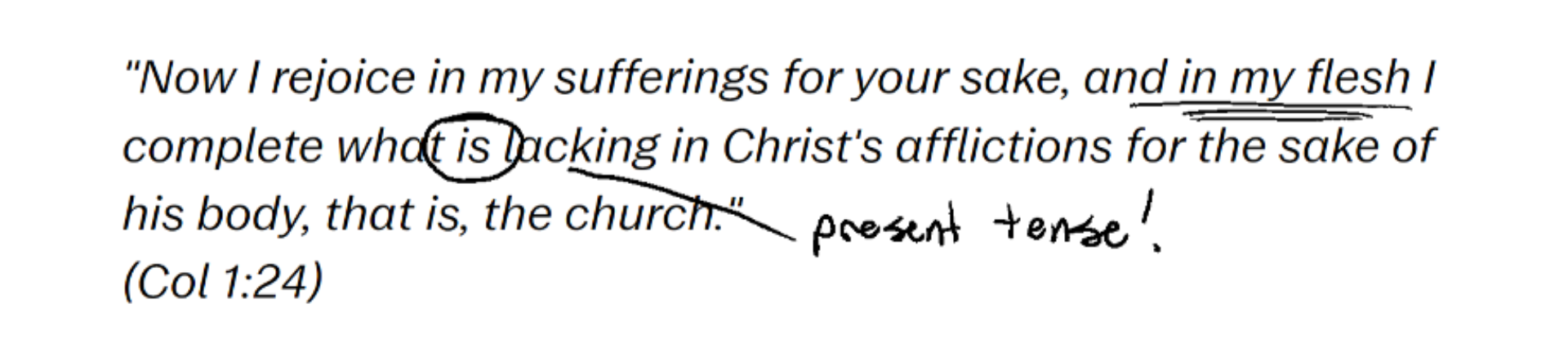
This is why Ciszek understood his 23 years in the Soviet Gulag as meaningful:
“I could not separate this earthly reality from the will of God, because the will of God has to be worked out by each of us here on earth… True Christian work [consists of] redeeming the world about [oneself], of being the leaven in the mass.”
We have in Cizsek’s profound words an opportunity to experience part of the “genius” of Christianity.
“Genius makes all things new for us. Genius is a seer, whose pre-eminent gift is to present reality to our minds under an unsuspected light, in the heart of a connected system which is a sort of new creation – that reality which was there, obvious, and which we did not see.” (The Intellectual Life, A.G. Sertillanges)
Work, yes even painful work, is a sacred calling, a divine invitation to enter into and share in the life of God, who is working, right now, in this present moment, to restore the original order and harmony in all creation.
Every single action of ours has the potential to be one of supernatural collaboration. Feeling and regulating our emotions when there’s tension in the room, choosing to get up in the morning when we don’t feel like getting up, exercising when we don’t feel like exercising, none of these things are meant to simply be “a pain in the butt”. They are invitations from God to participate with him, in a real and actual way, in the redemption of the world.
Christianized humanity is made up of various personalities, no one of which can refuse to function without impoverishing the group and without depriving the eternal Christ of a part of His kingdom. Christ reigns by unfolding Himself in men. Every life of one of His members is a characteristic moment of His duration; every individual man and Christian is an instance, incommunicable, unique, and therefore necessary, of the extension of the ‘spiritual body.’ If you are designated as a light bearer, do not go an hide under the bushel the gleam or the flame expected from you in the house of the Father of all… All roads but one are bad roads for you, since they diverge from the direction in which your action is expected and required. Do not prove faithless to God, to your brethren, and to yourself by rejecting a sacred call.” (The Intellectual Life, A.G. Sertillanges)
IV. What IS “Mystical” and What Is “Mundane”?
“He is before all things, and in him all things hold together.” (Col 1:17)
The goal of this reflection is to make the sacredness of work clearer.
At the same time, it’s intended to make something else less clear: the line inserted between what is “mystical” and what is “mundane”.
What is mysticism except the sharing in the life of God? What is work except the sharing in the life of God? What is “mundane” or “monotonous” that is not work?
“The moment comes when we can no longer distinguish where our prayer ends and our work begins, because our work is also prayer, contemplation, true mystical life of Union with God...” (St. Josemaría Escrivá)
A wise priest once described the Divine Liturgy as a time in which “bread and wine become what they were always meant to be.” In a way, transubstantiation is a return to the “old” form of bread and wine, rather than a changing into something “new”.
And the same truth is true of work. Work is not good simply because it can be used to “offer up suffering”, nor is it good because it’s been “sanctified” or “redeemed”. It’s good because it has always been good. Its goodness is “old”, not “new”, and we are invited to return and re-encounter it.
We end with the beginning:
Will you work today?