
I. Introduction
Overview
We are living in an age of overwhelm and disconnection. While some people are attempting to create clarity and connection in their lives, they are not experiencing the peace and fulfillment they desire because they are working with disconnected models and disconnected methods.
This essay introduces you to a connected method for personal development called hēl (pronounced like “heal”), by presenting its connected model of selfhood, organization, and spirituality.
A Note to the Reader
In this writing, I speak to you directly from my heart and being. In order to do that, I write freely, with full transparency, without any filter. You may have a different relationship with some of what I share or how I share it. I do not write with the assumption that you come from the same place as me belief-wise (some of you do, some of you don’t). I only write with the assumption that you are open-minded and are the kind of person who values interacting with another person’s real, genuine, and raw beliefs, rather than a “politically correct” version. I am assuming that you are the kind of person that “respects the raw”; that you are the kind of person who reverences wisdom and is eager to assimilate it, whether or not it “looks” or “sounds” like the forms of wisdom you have experienced in the past. As you read this essay and feel concepts presented in a different way, remain open and curious. For everything that feels new or different, you will get more out of this essay if you note these feelings and incarnate them into writing with questions like:
- “In what sense is this true?”
- “Why have I not thought of it this way before?”
- “If I disagree, what are the senses in which I agree? What are the senses in which I disagree?
- “If I agree, what new meaning does this new explanation provide?”
I encourage you to actively wrestle and interact with this essay. If you want it to really stick, email your written questions and thoughts to me (andy@hel.co), and I will send you back a personal response.
With care,

How to Read the Spiral
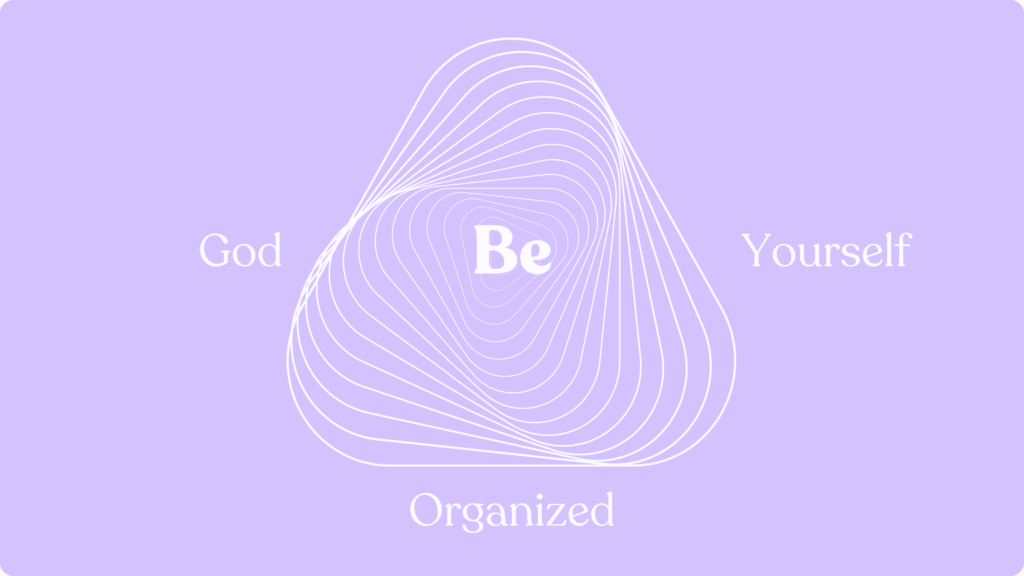
Hēl is a personal development method and community. When you look at hēl from a bird’s eye view, it is distilled down to three “Be” statements: Be Yourself. Be Organized. Be God. While these three statements might initially seem unrelated, hēl is founded on the belief that these three statements on being are intrinsically connected and represent a natural spiral.
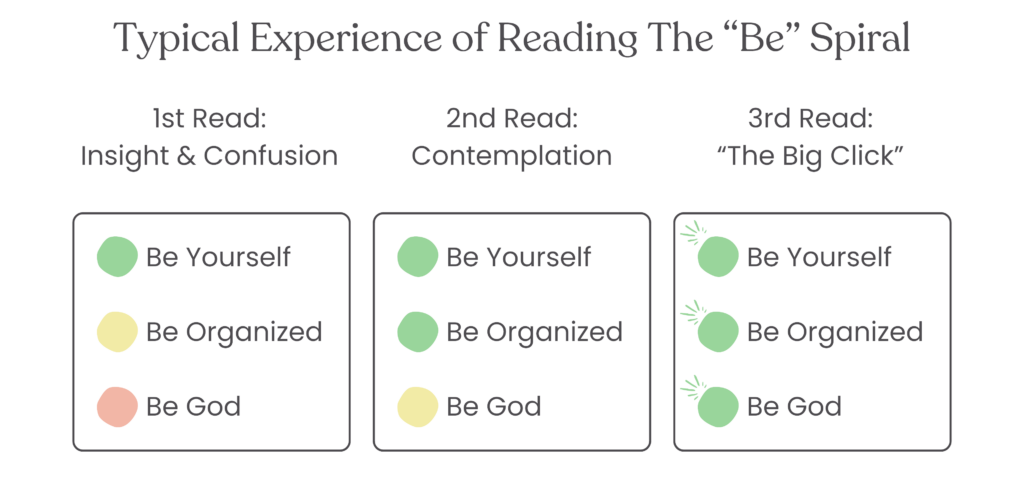
This essay is designed to be read repeatedly, in a spiral-like manner. Read through each “Be” once, and then, to begin seeing each “Be” in its fullness, re-read each one in light of the other two. You can only fully understand one “Be” when you look at it from the “eyes” of the other two “Be’s”. For example, if you are reading the section, “Be Organized”, and it’s not making sense, then that is a sign that the other two sections “Be Yourself” and “Be God” are yet to be fully understood as well. You may have thought you understood the previous “Be Yourself” section, but if “Be Organized” does not make sense, there are elements of “Be Yourself” that have yet to make sense as well. It is impossible to understand one section and not understand the other two sections because to understand one section fully is to understand the other two sections fully. And to not understand one section fully is to not understand the other two sections fully.
In an age when the written word is often cheapened and falls short of its promises; when many writers are so distracted by the speed and consistency of producing “content” that their writing unintentionally neglects and degrades their reader’s time and attention, you are invited to act differently with this essay than you may be used to. Unlike the innumerable “articles”, “blog posts”, and “newsletters” that are pushed in front of your eyes at such a high volume, this essay is a rich and highly conscious “meal for your mind”, written in a spirit of deep contemplation and love for you. If you choose to savor this essay and enjoy the process of reading it slowly, you will unlock an incredibly deep and renewing picture of reality that will transform the way you practically engage your “day-to-day”.
II. Be Yourself
“After the lingering hesitation of youth, which is so often tormented and perplexed, we had to reach the discovery of ourself, the perception of that secret urge within us which is directed towards some distant result of which we are not yet clearly conscious. Do you imagine that this is easy? Listening to oneself is a formula that amounts to the same thing as listening to god.”
– A.G. Sertillanges, The Intellectual Life
Is the self good or bad? Both? Should we be skeptical of it and keep it at a safe distance? Should we follow it “blindly”?
Without knowing it, we regularly use words that carry conflicting connotations about self.
On one hand, we describe self negatively with words like “selfish” and “self-centered”.
On the other hand, we describe self positively when we view it as important to have “some self-respect” and “self-confidence”.
It’s important that we conceive the self accurately. After all, self (“I”) is the primary way in which we experience life. We are continuously receiving information (physical sensations, thoughts, emotions, desires) through, in, and as self. What is the fundamental nature of this source and experience of information we call “self”?
We know the answer when we see it, and we see it when we see others. That is, there is something initially clearer about the fundamental nature of self when we look at the self in others, rather than in ourselves. If we only look at ourselves, we may experience a mixture of doubt, confidence, anxiety, and joy. There are too many mixed and conflicting experiences inside such that we may not feel confident in our judgement about the fundamental nature of self. But this cloud quickly fades away when our gaze moves up and out towards other people.
The golden rule is a good example: “You shall love your neighbor as yourself.” (Matthew 19:19). Like “water is good to drink”, the golden rule is immediately experienced as self-evident. Yet what is a fundamental assertion of the golden rule? “It is good to love others”. When we look at another person, it is clear that it is good to love that other person. Yet what is that other person except another “self”? Through the lens of love, we see the self, naked and original. We see the “inner man” (Eph 3:16), and we see that he is good. And when we understand how to distinguish him from his shadows, we enable ourselves to unravel the knots of our own language. Instead of living a divided life, where in one moment we conceive of self as good and the next moment we conceive of self as bad, we can choose to live the paradox of being oneself fully without being full of oneself; being full of pride without being prideful.
Yet two challenges remain: partiality and partitioning.
Partiality
“If you really fulfil the royal law, according to scripture, ‘You shall love your neighbor as yourself,’ you do well. But if you show partiality, you commit sin, and are convicted by the law as transgressors.”
– James 2:8-9
There is an obvious form of partiality: treating one person out there as lower than another person out there. There is also a more subtle and hidden form of partiality: treating this person “in here” as lower than another person out there.
Carl Jung’s words penetrate to the heart of the matter:
“To accept oneself as one is may sound like a simple thing, but simple things are always the most difficult things to do. In actual life to be simple and straightforward is an art in itself requiring the greatest discipline, while the question of self-acceptance lies at the root of the moral problem and at the heart of a whole philosophy of life.
Is there ever a doubt in my mind that it is virtuous for me to give alms to the beggar, to forgive him who offends me, yes, even to love my enemy in the name of Christ? No, not once does such a doubt cross my mind, certain as I am that what I have done unto the least of my brethren, I have done unto Christ.
But what if I should discover that the least of all brethren, the poorest of all beggars, the most insolent of all offenders, yes, even the very enemy himself—that these live within me; that I myself stand in need of the alms of my own kindness, that I am to myself the enemy who is to be loved—what then?
Then the whole Christian truth is turned upside down; then there is no longer any question of love and patience; then we say “Raca” to the brother within us; then we condemn and rage against ourselves! For sure, we hide this attitude from the outside world, but this does not alter the fact that we refuse to receive the least among the lowly in ourselves with open arms. And if it had been Christ himself to appear within ourselves in such a contemptible form, we would have denied him a thousand times before the cock crowed even once.”
– Carl Jung
These words move us to remember the sacredness of self. They awaken us to the hidden partiality of self-hatred, that unexpected, yet ultimate root of “self-centeredness”.
It is not enough to “love others”; for many “love others”, yet they keep themselves at an arm’s distance. They open their hearts to others yet remain suspicious of their own hearts. This manner of being is out of alignment with the spirit of the golden rule, which calls us to treat everyone with dignity, care, and respect. Much of this becomes clearer when we flip the golden rule over and consider it from another angle: “you shall love yourself as your neighbor.”
Only when we consciously move out of self-hatred, out of self-neglect, out of self-suspicion, out of self-criticism, even out of self-acceptance, and we move, positively, into self-love, are we able to truly be. Then, and only then, is the wind of God’s spirit able to assist the sail of self.
Partitioning
Let’s say you pass over that first, fundamental hurdle, and are now perceiving yourself as fundamentally good. Perceiving yourself as good still does not guarantee that you are conceiving of yourself accurately. Self-love must also be accompanied by self-knowledge.
A major reason why modern man feels so disconnected is simply because he is perceiving himself in a disconnected manner. If he has survived the drought of materialism, he may think himself balanced simply because he knows he “has a soul”. He might also even be aware of the other error across the aisle from materialism, that of “over-spiritualizing.” He might be able to recognize the unnatural vibe of those “overly spiritual” people who are “solemn” and “devout”, yet out of touch with their body. And while in the midst of this act of recognition, he might think to himself, “Yes, this is the middle way between the extremes of materialism and spiritualism: to no longer be just a body or just a soul, but to be both a body and a soul.” Even still, he is yet to be centered! For “spirit and matter, in man, are not two natures united, but rather their union forms a single nature.” (Catechism of the Catholic Church, paragraph 365).
Matter is not the opposite of spirit; it is, literally, spirit communicated (Gen 1:3). And spirit is not foreign to matter. Spirit matters – that is, it regularly manifests itself in and through matter.
All things are, when properly ordered, one unified thing, one seamless garment (Colossians 1:15-17). When we separate, we degrade the quality of the information – like degrading down from stereo to mono audio or from binocular to monocular vision.
This applies not only to spirit and matter, but also to our physical sensations, emotions, thoughts, and desires; not only to our makeup, but also to our movements. Feeling isn’t an emotional activity, thinking isn’t a mental activity, choosing isn’t an activity of the will. All of these actions are actions of the person.
Properly conceiving of yourself enables you to shift from living in your head, to being more sensible. Both Aristotle and Aquinas, the greatest ancient philosopher and the greatest medieval philosopher, point out that the physical senses are the foundation of thought. Aquinas writes that the senses are the “material cause of intellectual knowledge” (Summa I, 84, 6). Aristotle, to defend the opening claim in book 1 of Metaphysics that “all men desire to know” follows up by saying, “and we know this by the delight all men take in their senses” (Metaphysics, I.1).
When we integrate all of ourself into our actions, we act in a (and this is meant literally) common sense manner – that is, we operate from within “the space” where all our senses are brought together and synthesized into one, common sense.
If you are missing a sense of connection, it is in large part because you are missing a connection to your senses. Until your self-conception is restored, it is of little use to attempt to organize your life. If you aren’t fully experiencing your life, how are you to organize it? You can’t. You can certainly attempt to, but the experience of that attempt will be a frustrating one, similar to swimming upstream or trying to play a piano without its full set of keys. You won’t be able to organize your life. You will organize part of your life. You will create an imbalanced form of organization, often described as work-life imbalance.
When we learn how to reintegrate ourselves and experience ourselves as one unified whole rather than as an industrial set of faculties welded together, it’s a similar feeling to turning the wheel of a radio and moving through static until, suddenly, a clear signal is heard.
Now organization can begin. Yet, what exactly does it mean to organize something?
III. Be Organized
What Does It Mean to Organize?
To best understand the nature of organization, in this moment, shift a bit out of your “reading stance” and adapt an “exercise stance”. You’ll understand the nature of organization more deeply if you fully participate in this exercise:
Pause.
Take a big, deep breath down into your belly.
Let an equally full exhale out. Fully out.
Do that two more times – enjoy the process – take your time.
…
Now, imagine in your mind “organization”.
What kind of picture do you see when you imagine “organization”?
Grab something close by and draw a rough version of this picture.
…
Okay, what are you looking at when you look at your drawing? Describe it out loud (yes, actually speak out loud before reading further).
…
If you are like most people, you drew something that contains an essence of “neatness”, “things being tidy”, “things being under control instead of out of control”, or “a place for everything and everything in its place.”
Here is what you likely did NOT include in your imagination or in your depiction:
- Messiness
- Motion
- Activity
The word “organization” comes from the Greek, organon, which means “tool for making or doing.” In organization, we see the word, “organ” (as in bodily organs), which is the perfect image for organization.
Your bodily organs are not “tidy” or “neat”- they are even a little “messy” – but boy are they functional! How do we know that they are functioning? Movement. What is the ultimate sign of death? The flat line on a heart monitor. That sound, that sustained beeeeeeeep is the sound of stillness. When things are totally still, they are totally dead.
Yet many people carry a “still” and “tidy” image in their mind when they imagine organization. When they imagine their life organized, they imagine everything orderly and neat and in its place. No wonder they haven’t felt fulfilled in the past when they’ve tried to get organized – they’ve been doing the exact opposite of what organization actually is!
Organization is not about keeping things still; it is all about facilitating motion.
Organization is not about control; it is all about creativity.
Organization is not about putting out fires; it is all about lighting them.
What Are We Organizing?
It was important for us to lay the anthropological foundation for addressing the mistake of “partitioning” oneself, because even if you have the right image of what it means to organize something, you can still very easily fail to organize your life. You may succeed in organizing part of your life, but you will still experience that subtle, nagging sensation that “something is off”.
It simply does not cross the average person’s imagination that you can organize your emotions. Yet emotions are an integral part of the human person. They contain very important information, and you will experience an incomplete picture and an incomplete form of closure, fulfillment, and flow in your life if the organizational method you use is not capable of organizing emotions.
Intellectual interests are often left out of the picture as well. When you see, watch, hear, or read something and it touches something deep inside you, that is very important and very relevant to your happiness and the living out of your purpose. But the typical “planner”, “organizer”, or “app” simply has no space or framework for organizing something like this. It’s not even on the radar!
So, the emotions are out, the cultivation of your knowledge is out – what is left? What’s left is the sterile management of your time and your to-dos. That leaves you with two options:
Option 1: You manage the life out of your time and to-dos. You become a productivity machine (literally) and get really good and efficient at completing tasks, all while feeling really unfulfilled.
Option 2: You think you have to choose between being creative and being organized, and, because you have a big bleeding artistic heart, you give “being organized” the middle finger and identify as “one of those disorganized and artsy people.” And, inevitably, your art fails to make an impact on the world and to touch the hearts of the people who are hoping something like your art exists. And all because you don’t know how to manage your time and to-dos.
If you have a holistic conception of self and a holistic conception of organization, and a holistic method for organizing yourself, then you have a third option outside of that false dichotomy that so many fall into.
In this third, middle way, you:
- are personal AND systematic
- experience order AND ease
- spiral into control, rather than out of it
- are spontaneous, rather than reactionary
- flow, rather than force
- create, rather than constrict
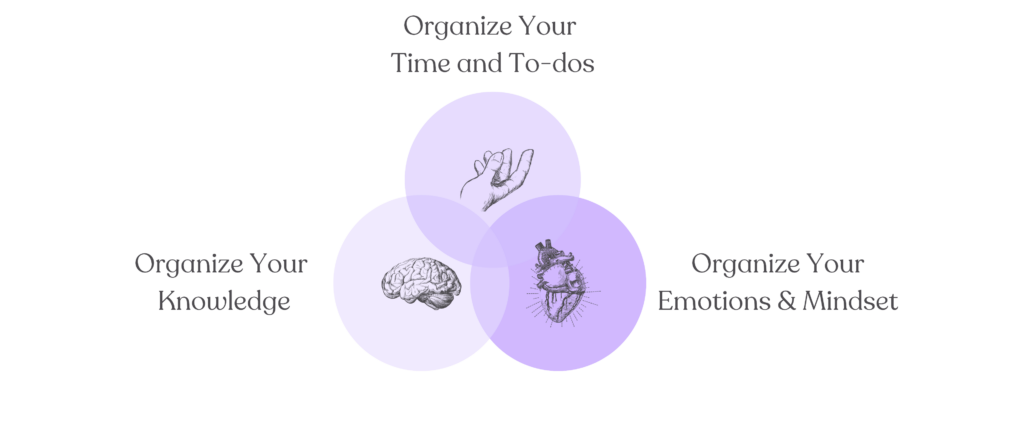
And you do this in all of your life, not just some of it. In both your “personal” and “professional” life, you are organizing your hands, your heart, and your head.
How Are We Organizing?
Hēl is the method for organizing your hands, heart, and head. It is comprised of four innate behaviors:
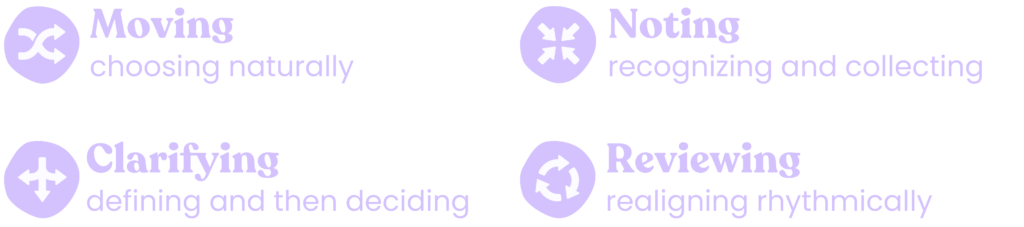
These behaviors are the essential elements – the “wedge”, “screw”, “wheel”, and “lever” – of organization.
There is much more than meets the eye here. I am fully aware that the definitions of those four behaviors feel very simple, maybe even obvious. They are simple. That is precisely why they create transformation. The transformation is the return from complexity to simplicity; in regenerating your awareness and practice of these behaviors until they become unconscious habits.
Why Are We Organizing?
Drawing from the above observations about the fundamental nature of self, the fundamental purpose of organizing your life is the sharing of your life. You bear the image of God, you are a glimpse of the divine, and – if you are organized – you are able to be “the light of the world” (Matthew 5:14-16). Organization is ultimately about being loved and being love. It is ultimately about being God.
IV. Be God
Depending on your background, you may be feeling some uneasiness about this combination of words. You might even feel disgust towards it. If that is you, Scripture, with power and gentleness, speaks to you these holy words:
“Awake, O sleeper, and arise from the dead… walk in a manner worthy of the calling to which you have been called.”
– Ephesians 5:14, 4:1
Being Christ = Being God
A central truth of Christianity is that Jesus Christ is both God and man. While that might roll off the tongue as something obvious, it should truly cause us to pause and reconsider that initial reaction of unease or disgust about us “being God”.
Why?
If Jesus Christ is true, then it is true that divinity and humanity can coexist in a single person.
“Hmm okay, but that’s possible for God, not for normal humans.”
Why do you think Jesus became a man?
“To save us from our sins.”
Is that the fullness of his vision for you? Did he not have a positive vision for you before sin entered the picture? Are his greatest plans dependent on you sinning? If you hadn’t sinned, would he have no reason for interacting with you? Scripture presents a very different picture; one in which God’s intention is primary and pre-exists any conversation about sin. In Ephesians, St. Paul writes that God’s plan was to “unite all things” in and through Christ, and that this plan was established “before the foundation of the world.”
“Blessed be the God and Father of our Lord Jesus Christ, who has blessed us in Christ with every spiritual blessing in the heavenly places, even as he chose us in him before the foundation of the world, that we should be holy and blameless before him. He destined us in love to be his sons through Jesus Christ, according to the purpose of his will, to the praise of his glorious grace which he freely bestowed on us in the Beloved. In him we have redemption through his blood, the forgiveness of our trespasses, according to the riches of this grace which he lavished upon us. For he has made known to us in all wisdom and insight the mystery of his will, according to his purpose which he set forth in Christ as a plan for the fullness of time, to unite all things in him, things in heaven and things on earth.”
– Ephesians 1:4-10
This original plan is so expansive that it is described as a “glorious inheritance”. It is so mindboggling that it is referred to as “the mystery”, which can only be received if the eyes of our hearts are enlightened. It is so generous that it is “lavished upon us”.
What is this original plan? It is for God to share his life with us; for us to partake in his divinity.
“His divine power has granted to us all things that pertain to life and godliness, through the knowledge of him who called us to his own glory and excellence, by which he has granted to us his precious and very great promises, that through these you may escape from the corruption that is in the world because of passion, and become partakers of the divine nature.”
– 2 Peter 1:4
An early Christian writer, St. Athanasius (296-373 AD) put it very succinctly: “For He was made man that we might be made God.” (On the Incarnation, Paragraph 54)
Jesus Christ’s mission neither begun nor ended with the forgiveness of our sin. Far from saying that Christ’s forgiveness is pointless, this is saying that there is a specific point, a specific intention behind his forgiveness. He forgives, so that he can reconcile, which means “to bring into agreement or harmony”; “to restore to union and friendship after estrangement or variance”; “to bring together again”. His mission, established “before the foundation of the world”, was to “unite all things in him”. “He destined us in love to be his sons through Jesus Christ”.
Again, we have an opportunity to awake from our slumber around words that we’ve heard before but not fully understood. If we are inattentive, we can domesticate being a “son of God” to meaning “being a good person” or “being on God’s team” or “being liked by God”. That is not what it means. It means what it means! Son.of.God. A divine child. A being that shares the same blood and life as God.
Christ, in bringing together divinity and humanity, is enabling and then modeling a life which he invites us to live: a life in which divinity and humanity coexist in us. This is why he says, “I am the way, and the truth, and the life…” (John 14:6) and instructs us to “Take my yoke upon you, and learn from me.” (Matthew 11:29).
This – the uniting of divinity and humanity – is what Scripture is referring to when it talks about:
- “the mystery of Christ” (Eph 3:4)
- “the unsearchable riches of Christ” (Eph 3:8)
- “the plan of the mystery hidden for ages in God who created all things” (Eph 3:9)
- “the eternal purpose” (Eph 3:11)
- “the love of Christ which surpasses knowledge” (Eph 3:19)
- “your glory” (Eph 3:13)
“The greater your knowledge of God becomes, the more you will realize the magnitude of his promises. When God blesses us, he changes our very being so that whatever we were by nature is transformed by the gift of his Holy Spirit, so that we may truly become partakers of his nature.”
– St. Bede (673-735 AD)
Being Christ = Being Yourself
Love is always communal and generative. Love implies a relationship between persons, and the dynamic of that relationship is the mutual flourishing of the persons. For example, if two people were in a relationship, but the dynamic of that relationship was such that one participant dominated and controlled the other, it wouldn’t be fitting to call that relationship loving.
God, who is himself a communion of three persons, does not desire to unite us “into him”, but to enter into union “with us”. He desires unity through diversity, rather than unity through uniformity. And he desires diversity through unity, rather than through division. He, reverences our distinctness. He in fact created it.
You image God in your otherness, in being a unique person distinct from him. Like a father rejoicing in seeing his son become “his own man”, or a generous mother’s heart being filled as her daughter “grows into a fine young woman”, when God sees us, our “self”, develop and flourish through freedom, he looks at us and says, “This at last is bone of my bone and flesh of my flesh.” By being yourself, you add another note into the divine harmony.
If you receive God’s spirit and life into your hearts, you do not lose your heart, you regain it. Purity of character is not the heart shrinking, it is the heart expanding. Self is restored and let loose. Unburdened from the tyrannical desires of disordered independence and disordered dependance, self is set free (John 8:32) and its sight is restored (Matthew 5:8). God wants you to experience deeper and deeper regeneration of yourself until, God willing, he can speak to you words like that spoken by Virgil to Dante at the gates of heaven:
“I’ve led you here by strength of mind, and art; take your own pleasure for your leader now. You’ve left the steep and narrow ways behind… No longer wait for what I do or say. Your judgment now is free and whole and true; to fail to follow its will would be to stray. Lord of yourself I crown and mitre you.”
– Dante Alighieri, Purgatorio XXVII
V. Recap
If you have just completed your first reading of The “Be” Spiral, read through each “Be” at least one more time before proceeding further into this recap.
If you have contemplated this essay by reading the spiral multiple times, please proceed into this recap.
In response to the overwhelm and disconnection of our time, many people are attempting to create clarity and connection but are using incomplete methods. They are trying to sail with incomplete sailboats.
- Some people have a sail, but keep it lowered and sheltered from the wind. These are people who feel wounds in their heart and do deep inner work but don’t understand how to translate that inner work into outer activity. They subconsciously feel that they have to choose between being or doing. They become addicted and dependent on rummaging into the past and forget that the point of healing isn’t the healing itself, but the living of one’s life.
- Some people are using a sail with a bunch of holes in it. These are people who feel chaos in their lives and attempt to “get organized” but only achieve in creating a false sense of organization (sterilizing stillness or control) in only part of their life (usually in their professional life and not in their personal life), in only part of themselves (usually in their hands, and not in their heart or head), using only part of themselves (only thinking and never making sense).
- Some people are trying to sail either (A) with only the wind and no sail or (B) with only a sail and no wind. Group A are the people who view themselves as fundamentally bad, rather than fundamentally good. They carry a lot of self-hatred, self-suspicion, and self-doubt. Their spirituality suffers from a formulaic approach and includes superstitious beliefs around prayer and/or “holy” objects. They want God to live their life for them and feel guilty pursuing desires that God plants in their hearts. Group B are the people who, typically in reaction to the errors of Group A, hold an artificially high view of themselves. They view themselves as spiritually self-sufficient. They believe they are and always have been God. They pursue a false form of freedom that crowds out their awareness of and sensitivity towards the promptings of the Holy Spirit. They rashly pursue any desire they feel without discerning its nature or source. Their spirituality suffers from a formlessness and includes superstitious beliefs around words and “natural” objects.
- Finally, some people are trying to raise their sail, patch the holes, and channel the wind, but are attempting to do this with a complicated set of foreign tools, rather than using their own hands. These are people who have a comprehensive understanding of where they want to grow but fail to make practical traction because they lack a holistic method that provides a simple and natural solution for the “how” piece. They are (1) attempting to reintegrate themselves, (2) pursuing an authentic form of organization in their life, and (3) trying to cultivate a sound spirituality, but they are conceiving of these three things as methodologically distinct. They create a lot of unnecessary complication and friction by using three different methods instead of creating simplicity and flow by using a single unified method.
Comprehending the full scope of problems a person faces and synthesizing disassociated attempts to resolve those problems, hēl uniquely provides a unified, practical, and natural method for creating clarity and connection in and with your life.
How to Begin Learning the Hēl Method
If you are interested in learning the hēl method, I have written a series of letters designed to introduce to you its practical elements. In these foundational letters you will:
- Study the four core behaviors that comprise the hēl method.
- Learn my personal story of how and why I developed the hēl method.
- Hear audio clips of hēl practitioners experiencing the method in real time.